XW inverters Fault F29/F30 - is it for AC1 or AC2?

pcguy2u
Solar Expert Posts: 161 ✭✭✭
An over voltage condition that is described as:
F29 (Over-voltage anti-islanding fault, caught by the qualification limit, voltage difference between L1 and L2) most every time and F30 (Over-voltage anti-islanding, fast disconnect, 270 V) at other times.
Anyone have any idea? Trying to implement an invert on demand setup (more later) and this is the stumbling block at the moment. No amount of searching provides insight. :0(
There is conflicting information, some of which suggests that it could be the batteries:
Potential Causes for Fault F29
- Battery Charger Settings: The battery charge voltage settings (e.g., Bulk, Absorption, or Equalize) are set too high for the battery bank.
- Faulty Battery Bank/BMS: If using Lithium batteries, the Battery Management System (BMS) may have disconnected, causing a voltage spike.
- Incorrect Battery Type Setting: The inverter is configured for a battery type that requires higher voltage than what is actually installed.
Battery settings were derived via support from Discovery Energy Systems.
TIA, Nick
Comments
-
Islanding is a grid warning but you need to describe which model XW and what frimware."we go where power lines don't" Sierra Nevada mountain area
htps://offgridsolar1.com/
E-mail offgridsolar@sti.net -
Original XW6048 with two MMPT-60 controllers with version 1.07.10 BN 3 firmware
-
Below are the last release notes for XW greybox. On number 3, are you in the limits? What does Discover say and which model?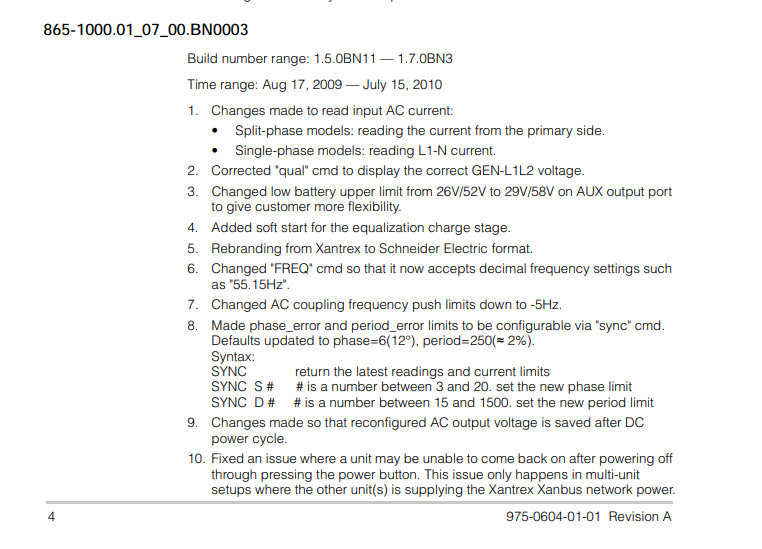
"we go where power lines don't" Sierra Nevada mountain area
htps://offgridsolar1.com/
E-mail offgridsolar@sti.net -
The setting that appears to be the most like the above number three reference is "Low Batt Cut Out". Discover Energy Systems has designated that setting for their rack mounted AES batteries as 48V.I have some frustration with Disc ES in that unlike most manufacturers of LiFePo4 batteries with BMS firmware, when using those batteries in an "Open Loop" configuration (such as most older inverters) they do/will not provide a chart that correlates the state of charge to a specific voltage level. An internet search for such a chart results in numerous graphics that are reasonably characterized as ubiquitous - they are all very similar and in some cases identical.I believe that the absence of that chart is intentional and designed to make warranty claims favor the manufacturer.I have redesigned my Invert on Demand project to avoid this issue and I'm moving on...
-
Are you using Lynk2 from Discover? You should be! Voltage is a poor way to get state of charge!"we go where power lines don't" Sierra Nevada mountain area
htps://offgridsolar1.com/
E-mail offgridsolar@sti.net -
Have not developed a way to utilize the SOC from the Lynk II with Open Loop. Maybe when the grid is down during the middle of the night, if I access the cloud I would be able use the SOC to determine if I need to shut down the use of the batteries. Even then though, the data that shows the SOC also shows the voltage. Think that association is not linear, but is a sliding scale; I'm gathering those numbers to see how close the AES numbers are to the more widely used chart numbers. Discovery seems to have created their SOC to voltage associations to be in concert with the specific manner in which the AES batteries perform; if that makes any sense.
-
Below is AI from Gemini. One of my clients did this, I think before he closed the loop.
1. Direct Visual Monitoring via LYNK II LEDsThe LYNK II Gateway features on-device LED indicators that display the aggregate State of Charge (SOC) in real-time, even in open loop.YouTube +2
- LED 1 (Solid): 6-20% SOC
- LED 2 (Solid): 21-40% SOC
- LED 3 (Solid): 41-60% SOC
- LED 4 (Solid): 61-80% SOC
- LED 5 (Solid): 81-100% SOC
- Flashing: 5% or below SOC
2. LYNK ACCESS Software MonitoringConnect the LYNK II to a computer via USB and use the LYNK ACCESS software to view real-time data, including SOC, voltage, and current for the connected battery bank."we go where power lines don't" Sierra Nevada mountain area
htps://offgridsolar1.com/
E-mail offgridsolar@sti.net


Categories
- All Categories
- 233 Forum & Website
- 140 Solar Forum News and Announcements
- 1.3K Solar News, Reviews, & Product Announcements
- 181 Solar Information links & sources, event announcements
- 894 Solar Product Reviews & Opinions
- 252 Solar Skeptics, Hype, & Scams Corner
- 22.5K Solar Electric Power, Wind Power & Balance of System
- 3.5K General Solar Power Topics
- 6.7K Solar Beginners Corner
- 1K PV Installers Forum - NEC, Wiring, Installation
- 2.1K Advanced Solar Electric Technical Forum
- 5.6K Off Grid Solar & Battery Systems
- 428 Caravan, Recreational Vehicle, and Marine Power Systems
- 1.1K Grid Tie and Grid Interactive Systems
- 656 Solar Water Pumping
- 816 Wind Power Generation
- 621 Energy Use & Conservation
- 623 Discussion Forums/Café
- 316 In the Weeds--Member's Choice
- 74 Construction
- 125 New Battery Technologies
- 108 Old Battery Tech Discussions
- 3.8K Solar News - Automatic Feed
- 3.8K Solar Energy News RSS Feed