Decision fatigue, feeling a little overhwelmed

Good Day
I’ve been itching to “go solar” to some degree for many years. Here’s a little bit about us and our situation that will hopefully help us glean excellent advice from you folks.
Wife and I are 60, retired, living in Central Maine. We have a 2,000 SF colonial, decently weatherized with wood heat, central HWBB boiler, and 2 mini-splits for backup heat/cooling. (We live in the woods, decent shade, and NEVER use the mini splits on anything but “dry”). For hot water, we have both a boiler mate coming off the boiler, which we use in the winter, then spring we shut the boiler (and boilermate) off and use 60 gallon hybrid hot water heater. We have 2 upright freezers, and 2 full-sized refrigerators. We’re not “all out preppers” but pretty close. Finally, we have a 12K standby Kohler whole house generator. My “dream” is to have enough battery power so that in a 12-18 hour power failure we’d run strictly off batteries. For longer periods, we’d run generator during the day, batteries at night.
That said, I know about Will Prowse’s website and videos, but haven’t submerged myself completely in a deep dive yet. I’m aware of Eco-Flo and have heard that they go on sale and they’re a good bet when they do. I just don’t know a good price from a bad price.
Finally, I’m JUST starting to become more and more DIY. I can paint, replace a board, and I’ve got good common sense figuring out what’s wrong with things when they don’t work. But I’m NOT plumbing or electric knowledgeable AT ALL and MAYBE I’d be open to DIY solar / battery build, but I’d RATHER not if I can afford not to.
Love to hear some suggestions. PLEASE let me know if I can give more detailed information.
Ken LaVoie
Winslow, Maine
Comments
-
One step in the decision making process is to figure out which loads you want to run with your system.A good starting point is this load calculator at the link below, it will help you in eventually sizing a solar panel array if you go that route, an inverter, and battery storage size. After you come up with your projected daily usage you can ask for more detailed help.You can use the load calculator without sending it in an to NAZOr send it in for a consult if you like.If you are looking at using solar panels this link is very informative link about sizing a solar array.
-
Several comments...
Shade--That is a solar panel killer (very harsh for solar electric where one or a couple small branches worth of shade can easily kill 50% or more of a solar electric array's output). Solar hot water is a bit more shade tolerant--Basically solar hot water output falls by percentage of solar shading.
With the higher voltage inverter-chargers (500 Volt or more), it can be very cost effective if you can (for example) put the array 100 or more feet away from your home, and still use relatively small copper cables to carry the power...
Power = Voltage * Current
A 400 Volt Vmp array * 20 amps = 8,000 Watts of transmitted power. Vs the older systems which may have a 72 volt array and roughly 111 Amp current... "Older" low voltage solar tech made installing "remote solar arrays" much more difficult and expensive.
If you cannot install an array in a relatively open area (no trees, no buildings, no mountains/deep valleys, etc.) worth of shade, solar electric may not be practical for your location.
Just to look at a very rough off grid (I.e., battery based) system, 10,000 Watt array, 45 degree tilt, assume 55% average system efficiency, Bangor Maine, will (on average) produce:
https://pvwatts.nrel.gov/pvwatts.php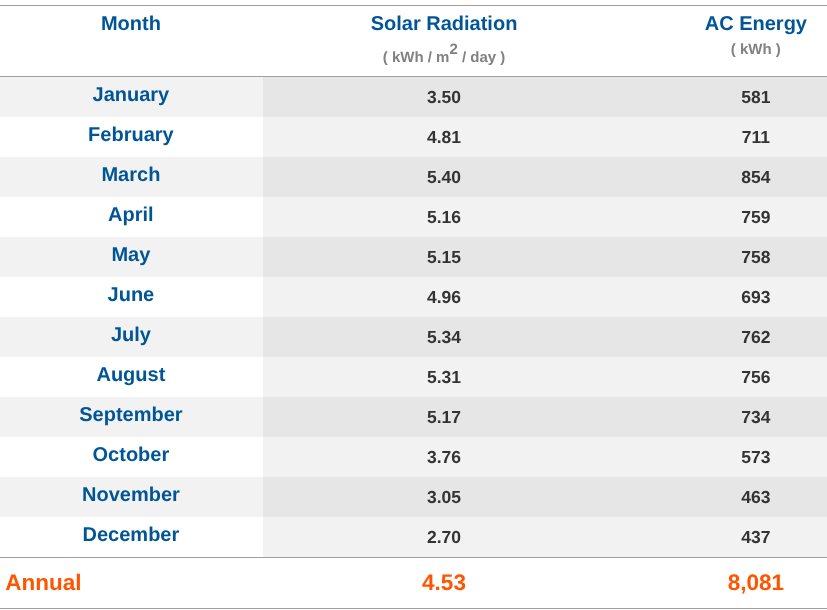
400-900 kWH per month is not a large amount of harvest from a 10,000 Watt (open field) array...
If you go full off grid, then over-sizing the array/battery bank, etc. to allow for storms and minimize Genset usage is pretty typical (I.e., array should be ~2x larger to support multiple days of bad weather, larger battery bank, and such to minimize Genset usage).
The other thing to look at is Genset sizing/fuel usage.
https://www.lowes.com/pd/KOHLER-RESV-12000-Watt-Dual-Fuel-Liquid-Propane-Natural-Gas-Home-Standby-Generator/5013797363
Roughly 2.9 gallons per hour at full load or 12,000 Watts.... Realistically, you will want to run from 50% to 80% of rated capacity (charging batteries at >80% of generator capacity) is very hard on the Genset (non-commercial gensets don't like hours of >80% loads as seen when charging a large battery bank).
And with Propane/Natural Gas/Gasoline gensets (non-Inverter Generator) type fuel consumption does not drop much when loads fall below 50% of rated load... I.e., from 0-6,000 Watt loads, the Genset will (very roughly) consume around (2.9 gph / 2 = ) 1.45 GPH of propane... Very inefficient if, for example, you are running from Genset with an average 2,000 Watt load on a 12,000 Watt genset--Roughly 3x the fuel usage per kWH vs running on a 3,000 Watt Genset.
If you get a 3,000 Watt inverter-generator, they can run pretty fuel efficient down to 25% of rated load (inverter-generators reduce engine RPM and fuel usage by slowing the engine speed and use the "inverter" to keep your 120 VAC / 60 Hz load).
If you only plan on running the Genset 1 week out of the year (ice storm takes down your power lines)--Fuel efficiency/costs are less of an issue... If you need to run the Genset 3 months out of the year (poor weather, poor sun, "off grid")... Then optimizing generator size to battery bank charging to loads to solar array sizing is going to more important.
For example, running the Genset at 6,000 Watt or less loads for 1 month at 12 hours per day:
1.45 GPH * 12 hours * 30 days per month = 522 Gallons per Month
Assume $3.30 per gallon of propane delivered in Bangor:
522 Gallons * $3.30 per gallon = $1,722.60 to run Genset 12 hours per day per month
Anyway... Lots of guesses from my side. Not to say that these numbers will be anywhere near what things will cost you--But more or less give you an idea of how you can "model" your energy needs vs costs.
Are you looking for emergency backup power or reducing your energy costs (as an example).
Solar can be a poor candidate for far north/wooded lots. And a nice/large Genset can be a $$$ sink for fuel costs. Add maintenance costs and repairs--An over-sized (vs loads) Genset can be expensive in its own right.
-Bill
Near San Francisco California: 3.5kWatt Grid Tied Solar power system+small backup genset -
Seems I've seen more people lately who're not so interested in solar but want only want a battery and inverter for outages. I certainly understand that. We're off grid with solar in a PNW canyon and forest and during the winter that's just what we do every day because of lack of sunlight. We get a whopping 1 to 2 kWh per day at best for 2.5 months which doesn't go very far. So the generator runs every evening from 6 to 9-10pm to charge the batteries for the next day. For the rest of the year the genset rarely runs.
But our biggest load in the house, including the water well, is the microwave. And we use that sparingly in the winter. For the OP, being used to grid power or that big 12kw, it's gonna be an expensive backup system me thinks.
Example of tough decisions:
https://www.bbc.com/news/articles/c1dz0dz0zkvoOff Grid. Two systems: 1) 2925w panels, OB VFXR3648, FM80, FNDC, Victron BMV-712, Mate3s, 240 xformer, four SimpliPHI 3.8; 2) 780w, Morningstar 30a, Grundfos switch, controller and AC/DC pump, 8 T105. Honda EU7000is w/AGS. Champion 3100. HF 4550, Miller Bobcat. -
OP…check out this thread from a Maine offgridder. It’s from the DIYSolar forum. BB gave his ok for me to post this.Off-Grid in Terlingua, TX
5,000 watt array - 14 CS 370 watt modules - 7S2P. HZLA horizontal tracker. Schneider: XW6048NA+, Mini PDP, MPPT 80-600, SCP. 650ah LiFeP04 battery bank - 5 Discover AES 42-48-6650 48 volt 130ah LiFePO4 batteries




Categories
- All Categories
- 233 Forum & Website
- 140 Solar Forum News and Announcements
- 1.3K Solar News, Reviews, & Product Announcements
- 181 Solar Information links & sources, event announcements
- 895 Solar Product Reviews & Opinions
- 252 Solar Skeptics, Hype, & Scams Corner
- 22.5K Solar Electric Power, Wind Power & Balance of System
- 3.5K General Solar Power Topics
- 6.7K Solar Beginners Corner
- 1K PV Installers Forum - NEC, Wiring, Installation
- 2.1K Advanced Solar Electric Technical Forum
- 5.6K Off Grid Solar & Battery Systems
- 428 Caravan, Recreational Vehicle, and Marine Power Systems
- 1.1K Grid Tie and Grid Interactive Systems
- 656 Solar Water Pumping
- 816 Wind Power Generation
- 621 Energy Use & Conservation
- 623 Discussion Forums/Café
- 316 In the Weeds--Member's Choice
- 74 Construction
- 125 New Battery Technologies
- 108 Old Battery Tech Discussions
- 3.8K Solar News - Automatic Feed
- 3.8K Solar Energy News RSS Feed