Understanding Circuit Topology and Thermal Dynamics in 3S (12.6V 5A) Lithium-Ion Charging Systems

For off-grid instrumentation, solar-powered telemetry stations, or small DC micro-grids, a 3S (11.1V nominal) lithium-ion battery configuration is frequently deployed. It sits in a useful voltage sweet spot, closely aligning with legacy 12V automotive and lead-acid hardware rails while offering the energy density advantages of lithium chemistry.
However, charging a 3S lithium pack efficiently at a moderate current—like 12V 5A lithium ion charger—presents specific thermal and regulation challenges that require careful hardware selection.
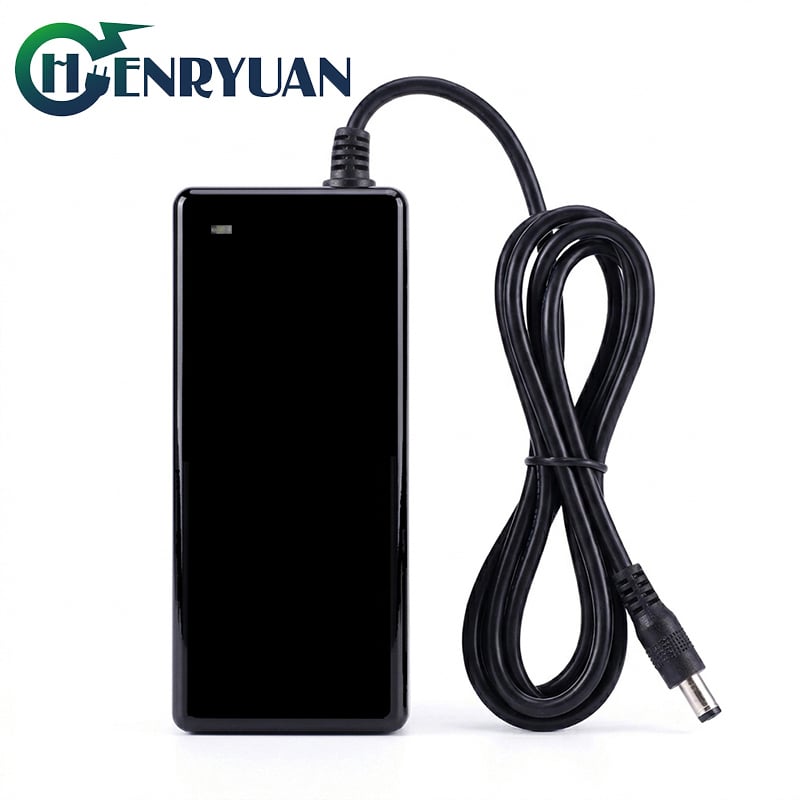
Below is an engineering analysis of the closed-loop feedback mechanics, efficiency considerations, and global safety standards involved in steady-state 3S 5A charger.
1. The Mechanics of the CC/CV Transition PointA standard 3S lithium-ion pack requires an exact maximum saturation voltage of 12.6V (4.2V per cell in series). Achieving full state-of-charge (SoC) without triggering the pack’s internal Battery Management System (BMS) over-voltage protection requires strict compliance with the Constant Current / Constant Voltage (CC/CV) charging curve.
During the bulk Constant Current (CC) phase, the charger drives a flat 5A rail into the cells. As the cell impedance increases and the aggregate voltage approaches 12.6V, the internal loop must seamlessly clamp the voltage.
In industrial-grade topologies, this regulation is achieved via high-precision analog feedback loops (typically utilizing an optocoupler coupled with a precision reference source like a TL431). The circuit continuously compares the output voltage against an internal stable reference. If the voltage drifts much due to component aging or temperature coefficients, it can cause severe long-term capacity degradation or trigger a premature BMS cutoff.
2. Reliability: Analog Voltage Equilibrium vs. Digital CutoffsA common point of discussion in field hardware reliability is whether to use digital microcontrollers (MCUs) to actively switch off a charger or to rely on standard analog hardware mechanics.In high-reliability or continuous-duty environments, pure analog hardware-driven closed loops are often preferred for low-to-mid-power brick adapters due to their high Mean Time Between Failures (MTBF):No Firmware Vulnerability: Microcontrollers running code can experience program hangs, clock jitter, or code runaway if subjected to electrostatic discharge (ESD) or line surges from a solar charge controller's inductive switching load.Natural Physical Equilibrium: An analog charger relies on basic voltage potential matching. As the battery voltage reaches exactly 12.6V, the potential difference (Delta V) between the power supply and the battery collapses. Following Ohm's Law (I = Delta V/R), the current naturally tapers down to zero with absolute physical certainty.Because the shutdown mechanism is a direct result of electrical balance rather than a software decision, the system eliminates digital failure modes that could lead to an unchecked overcharge state.
3. Thermal Management at 63 Watts Continuous OutputDelivering 12.6V at 5A means the power supply operates at roughly 63 Watts of continuous output power (12.6V * 5A = 63W). At this power density, internal thermal dissipation is a major design constraint, especially in passively cooled sealed desktop enclosures.To maintain component longevity without resorting to mechanical cooling fans (which introduce a mechanical failure point), the internal layout must optimize heat transfer. High-efficiency switching topologies (typically flyback or resonant LLC converters) are required to minimize switching losses in the primary MOSFETs and secondary rectification diodes. Furthermore, bonding the magnetic components (transformers and inductors) and power semiconductors directly to heavy-gauge aluminum heatsinks via thermal interface materials (TIM) ensures that internal temperatures stay well within the safe operating envelope of the bulk electrolytic smoothing capacitors.
4. Global Regulatory Compliance & Safety Isolation
When deploying solar-hybrid or grid-tied battery charging stations, the power adapter serves as the primary safety barrier between AC mains utility lines and the low-voltage DC battery system. Component-level testing certification is non-negotiable for mitigating liability and ensuring fire safety.
For a 12.6V 5A power supply to be safely deployed on an international scale, its physical and electrical architecture must meet a highly stringent cross-border regulatory matrix:
North America: UL / cUL listing and FCC certification, validating insulation creepage distances, dielectric breakdown thresholds, and electromagnetic interference (EMI) limits.
Europe & UK: CE marking and UKCA compliance, ensuring adherence to low-voltage safety and harmonized radio disturbance standards.
Asia-Pacific: PSE (Japan) and SAA (Australia/New Zealand) certifications, which mandate specific testing for fault conditions, thermal runaway resistance, and regional plug configuration isolation.
Ensuring these standards are baked into the power brick's design guarantees that the component can handle line voltage spikes, grid fluctuations, and harsh operating environments without compromising the integrity of the downstream lithium battery pack.
For those running small off-grid lithium banks via 12V AC inverters or grid backups, what topology have you found most reliable for long-term continuous charging? Do you prefer pure analog passive bricks for their resilience against EMI, or do you opt for smart, communication-capable digital chargers?
Categories
- All Categories
- 230 Forum & Website
- 137 Solar Forum News and Announcements
- 1.3K Solar News, Reviews, & Product Announcements
- 181 Solar Information links & sources, event announcements
- 892 Solar Product Reviews & Opinions
- 252 Solar Skeptics, Hype, & Scams Corner
- 22.5K Solar Electric Power, Wind Power & Balance of System
- 3.5K General Solar Power Topics
- 6.7K Solar Beginners Corner
- 1K PV Installers Forum - NEC, Wiring, Installation
- 2.1K Advanced Solar Electric Technical Forum
- 5.6K Off Grid Solar & Battery Systems
- 428 Caravan, Recreational Vehicle, and Marine Power Systems
- 1.1K Grid Tie and Grid Interactive Systems
- 656 Solar Water Pumping
- 816 Wind Power Generation
- 620 Energy Use & Conservation
- 623 Discussion Forums/Café
- 316 In the Weeds--Member's Choice
- 74 Construction
- 125 New Battery Technologies
- 108 Old Battery Tech Discussions
- 3.8K Solar News - Automatic Feed
- 3.8K Solar Energy News RSS Feed